Postmark error 406: "You tried to send to a recipient that has been marked as inactive"
ErrorCode 406 means Postmark refused to send because the recipient is on the suppression list of the message stream you sent through: the address hard bounced, marked one of your emails as spam, or was suppressed manually. Postmark won't send to it again until it is reactivated. Hard bounces and manual suppressions can be reactivated in the stream's Suppressions tab or through the API; spam complaints can only be reactivated by Postmark support.
What the error looks like
A single send to POST /email fails with HTTP 422 and this body. The message lists every inactive address it found:
{
  "ErrorCode": 406,
  "Message": "You tried to send to a recipient that has been marked as inactive. Found inactive addresses: [email protected]. Inactive recipients are ones that have generated a hard bounce, a spam complaint, or a manual suppression. "
}
The batch endpoint (POST /email/batch) behaves differently: the request returns HTTP 200 and each message in the response array carries its own ErrorCode. A batch where one entry has "ErrorCode": 406 is easy to miss if your code only checks the HTTP status.
The code is also echoed in the X-PM-ApiErrorCode response header, so you can branch on 406 without parsing the message text.
Why the address is inactive
Postmark deactivates an address when a bounce or event of one of these types arrives. In rough order of how often you'll meet them:
| Reason | Bounce type (TypeCode) | Can you reactivate it? |
|---|---|---|
| The mailbox doesn't exist or permanently refused mail | HardBounce (1) | Yes, but it usually bounces again unless something changed |
| Someone suppressed it by hand, or the recipient unsubscribed | ManuallyDeactivated (100002) / suppression reason ManualSuppression | Yes, if the recipient asked or it was a mistake |
| The recipient marked your email as spam | SpamComplaint (100001) | Not yourself: contact Postmark support |
Suppressions belong to a message stream. If you send with "MessageStream": "broadcast" and look at the outbound stream's list, you won't find the address. When MessageStream is left out, Postmark sends through outbound.
Find the record behind the 406
Search bounces for the address. inactive=true keeps only bounces that deactivated it, and messagestream defaults to outbound if you leave it out:
curl "https://api.postmarkapp.com/bounces?count=50&offset=0&[email protected]&inactive=true&messagestream=outbound" \
  -H "Accept: application/json" \
  -H "X-Postmark-Server-Token: $POSTMARK_SERVER_TOKEN"
In each bounce, read Type (why), Details (the receiving server's answer, such as a 550 user-unknown line), Inactive and CanActivate. If CanActivate is false, you can't reactivate it through the API.
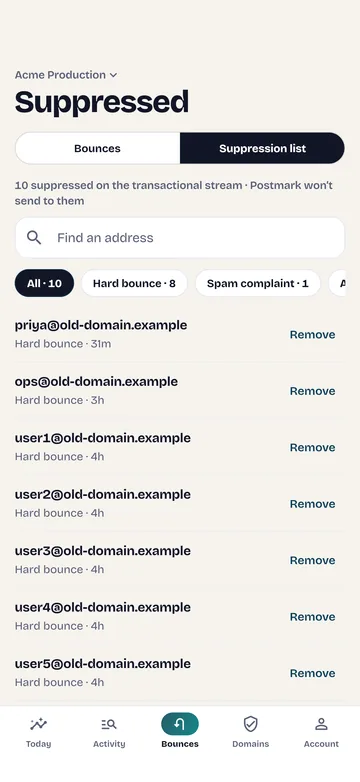
Or look the address up in the stream's suppression list, which also covers manual suppressions:
curl "https://api.postmarkapp.com/message-streams/outbound/suppressions/[email protected]" \
  -H "Accept: application/json" \
  -H "X-Postmark-Server-Token: $POSTMARK_SERVER_TOKEN"
Each entry has a SuppressionReason (HardBounce, SpamComplaint or ManualSuppression), an Origin (Recipient, Customer or Admin) and CreatedAt.
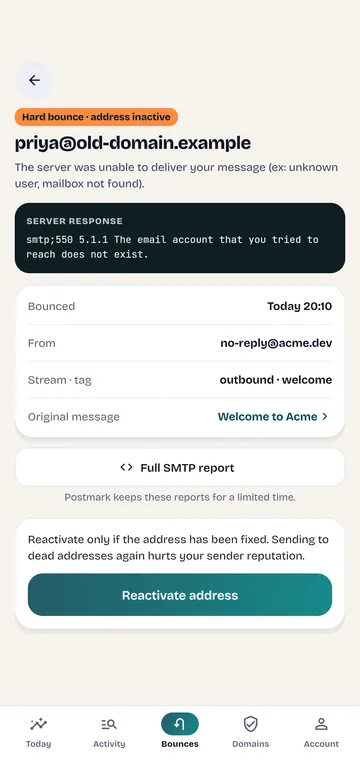
Reactivate the address, if you should
Only reactivate when you have a reason to think the next email will arrive: the recipient fixed their mailbox, a typo in the address was corrected at the source, or the suppression was a mistake. Otherwise the next send hard bounces again and the address goes straight back on the list.
Reactivate one bounce by its ID:
curl "https://api.postmarkapp.com/bounces/692560173/activate" \
  -X PUT \
  -H "Accept: application/json" \
  -H "Content-Type: application/json" \
  -H "X-Postmark-Server-Token: $POSTMARK_SERVER_TOKEN" \
  -d ""
Or remove the suppression from the stream (up to 50 addresses per call). Postmark says deleting a HardBounce suppression is the same as reactivating the bounce:
curl "https://api.postmarkapp.com/message-streams/outbound/suppressions/delete" \
  -X POST \
  -H "Accept: application/json" \
  -H "Content-Type: application/json" \
  -H "X-Postmark-Server-Token: $POSTMARK_SERVER_TOKEN" \
  -d '{"Suppressions": [{"EmailAddress": "[email protected]"}]}'
The response is HTTP 200 even when an address can't be removed, so check each item's Status: Deleted, or Failed with a reason. For a spam complaint the reason is You do not have the required authority to change this suppression. Reactivating doesn't resend the emails that were rejected; send them again yourself.
Stop it happening again
- Handle 406 in code. Treat it as final for that address: flag the user's email as undeliverable and ask them to update it, instead of retrying.
- Check batch responses per message, not just the HTTP status.
- Keep your own list in step. The bounce, spam complaint and subscription change webhooks tell you when Postmark deactivates or reactivates an address, so your app can stop queuing mail to it.
- Don't reactivate in bulk to clear the errors. Repeated sends to dead addresses raise your bounce rate.
Questions
What HTTP status does Postmark return with ErrorCode 406?
HTTP 422 for a single send. In a batch send the request returns HTTP 200 and the 406 appears on the affected message in the response array.
Does reactivating an address resend the failed email?
No. Postmark only lets you send new messages to the address again; anything rejected while it was inactive has to be sent again by your app.
Can I reactivate an address that made a spam complaint through the API?
No. The bounce has CanActivate set to false and the suppressions delete call returns Failed. If the recipient asks to get your email again, contact Postmark support with evidence of their request.
Why does the address show as active in one stream but give 406 in another?
Suppression lists are per message stream. Check the list of the stream named in your MessageStream field, or outbound if you didn't set one.
Related
- Reactivate a bounced address in Postmark (UI and API)Reactivate in the stream's Suppressions tab, with PUT /bounces/{id}/activate or the suppressions delete endpoint. Spam complaints need Postmark support.
- Postmark spam complaints: what they mean, what to doA Postmark spam complaint (SpamComplaint, 100001) deactivates the address at once, and only Postmark support can reactivate it. How to cut the rate.
- Postmark API error codes: every code and what to doPostmark returns an ErrorCode with a Message, mostly with HTTP 422. Table of codes from 10 to 1502 with meanings, HTTP status and whether to retry.
- Postmark message streams: transactional, broadcast, inboundEach Postmark server has an outbound transactional stream and an inbound stream; you add broadcast streams. Pick one per email with MessageStream.
- Hard bounce vs soft bounce: what each means, what to doA hard bounce is a permanent failure (5xx, e.g. 550 5.1.1): stop sending to it. A soft bounce is temporary (4xx, e.g. full mailbox): retry, then stop.