Why DMARC fails (even when SPF or DKIM passes)
DMARC fails when neither SPF nor DKIM passes for a domain that is aligned with the From address. A pass on someone else's domain does not count: if your provider signs with its own DKIM domain and uses its own Return-Path, SPF and DKIM both pass and DMARC still fails. The fix is DKIM signing on your own domain, ideally plus a custom Return-Path, for every service that sends as you.
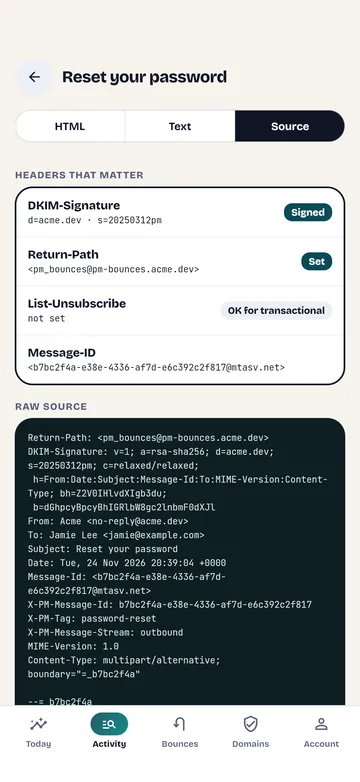
- Find a failing message Open its full headers and compare header.from with header.d (DKIM) and smtp.mailfrom (SPF).
- Set up DKIM on your domain Publish your provider's DKIM record for the From domain and verify it in the provider.
- Add a custom Return-Path Point a bounce subdomain of your domain at the provider so SPF also aligns.
- Cover every sender Use DMARC aggregate reports to find other tools sending as your domain and set up DKIM in each.
- Re-test Send a new message and confirm dmarc=pass before tightening the policy.
Pass is not enough: alignment
DMARC looks at the domain in the visible From header (the Author Domain) and asks whether an authenticated domain matches it. RFC 9989, which replaced RFC 7489 in 2026, keeps the two modes: relaxed (the default), where the domains share an organisational domain, and strict (adkim=s or aspf=s), where they must be identical. For SPF only the envelope sender (MAIL FROM, shown as smtp.mailfrom) counts; for DKIM, the signature's d= domain.
| From | SPF passes for | DKIM passes for | DMARC |
|---|---|---|---|
example.com | pm-bounces.example.com | example.com | pass (both aligned) |
example.com | bounces.example.net (provider) | example.net (provider) | fail: both pass, neither aligns |
example.com | fails (forwarded) | example.com | pass via DKIM |
example.com | example.com | fails (body changed) | pass via SPF |
example.com with adkim=s; aspf=s | pm-bounces.example.com | mail.example.com | fail: strict needs an exact match |
What causes DMARC to fail, most common first
- DKIM is not set up on your domain at the provider. The provider signs with its own domain, so
dkim=passshows aheader.dthat is not yours. Publish the provider's DKIM record for your domain and verify it. - A third-party tool sends as you. Billing, helpdesk, CRM or a form plugin puts
From: [email protected]on mail it signs with its own domain. Aggregate reports show these as sources you do not recognise. Set up DKIM for your domain in each tool, or send from a subdomain they own. - Forwarding and mailing lists. A forwarder sends from its own IP, so SPF fails; a list that adds a footer or a subject tag breaks DKIM. With both broken, DMARC fails. Aligned DKIM survives plain forwarding, which is why it matters more than SPF.
- DKIM broke after a DNS change. A key lost in a DNS move or rotated badly. See DKIM fail.
- Strict alignment on a domain that sends from subdomains. Remove
adkim=sandaspf=sunless you need them; RFC 9989 notes that nearly all domain owners find relaxed alignment sufficient. - A From domain you do not control. Sending
From: [email protected]through a provider cannot pass DMARC, because only Google can sign forgmail.com.
Read dmarc=fail in the headers
The second row of the table above looks like this in a message's headers:
Authentication-Results: mx.example.net;
  dkim=pass header.d=example.net header.s=s1;
  spf=pass smtp.mailfrom=bounces.example.net;
  dmarc=fail header.from=example.com
The giveaway is header.d and smtp.mailfrom on a domain other than header.from. Receivers add their own details. Microsoft documents dmarc=pass|fail|bestguesspass|none with an action, for example:
dmarc=fail action=none header.from=contoso.com
dmarc=fail action=oreject header.from=contoso.com
Its compauth reason 000 means the message failed DMARC and the policy was p=quarantine or p=reject. Other receivers print your published policy in brackets, such as p, sp and the disposition they applied; dmarc=fail with p=none means the check failed but you asked for no action.
What the receiver does with a failure
| Your policy | Typical outcome |
|---|---|
p=none | Delivered or filtered on other signals; you still get aggregate reports |
p=quarantine | Spam folder |
p=reject | Rejected at SMTP. Gmail: 5.7.26 Unauthenticated email from example.com is not accepted due to domain's DMARC policy. Microsoft: 550 5.7.509 Access denied, sending domain [EXAMPLE.COM] does not pass DMARC verification and has a DMARC policy of reject. |
Gmail also enforces alignment for bulk senders regardless of your policy: Your email has been rate limited because the From: header (RFC5322) in this message isn't aligned with either the authenticated SPF or DKIM organizational domain. (4.7.32). Google says DMARC alignment isn't required for forwarded or mailing list messages.
Fix it per provider
- Postmark: verify the DKIM TXT record for your domain, and add a custom Return-Path (
pm-bounces.example.comCNAME topm.mtasv.net) for aligned SPF. - SendGrid: complete domain authentication; its CNAMEs give you aligned DKIM and an aligned bounce domain.
- Mailgun: verify the sending domain's DKIM TXT and SPF records.
- Resend: verify the domain; DKIM is on
resend._domainkeyand the Return-Path defaults tosend.example.com.
Then read your DMARC aggregate reports to find any other source still failing.
Questions
Why does DMARC fail when SPF and DKIM pass?
Because they passed for a domain that is not aligned with your From address, usually your provider's own domain. DMARC only counts aligned passes.
What does dmarc=fail with p=none mean?
The message failed DMARC, but your policy asks receivers to take no action. It still shows up in your aggregate reports, and it may still be filtered on other signals.
Does DMARC need both SPF and DKIM to pass?
No. One aligned pass is enough. Gmail and Yahoo still require bulk senders to set up both SPF and DKIM.
Can forwarding make DMARC fail?
Yes, if the forwarder also changes the message and breaks DKIM. Plain forwarding breaks SPF but leaves an aligned DKIM signature intact, so DMARC still passes.
Related
- DKIM fail: what it means and how to fix each causedkim=fail means a signature did not verify: the body changed, signed headers changed, or the key is missing from DNS. Find the reason and fix it.
- SPF fail, softfail and neutral: what they meanSPF fail: the sending IP isn't in the Return-Path domain's SPF record and it ends in -all. Softfail (~all) is weaker, neutral (?all) says nothing.
- How to read a DMARC report (with an example)A DMARC aggregate report is daily XML from each mailbox provider: one record per sending IP, with counts and SPF/DKIM results. An example, line by line.
- Custom Return-Path domain: why and how to set it upA custom Return-Path puts bounces on your own subdomain so SPF aligns for DMARC. On Postmark: CNAME pm-bounces.example.com to pm.mtasv.net, then verify.
- SPF, DKIM and DMARC explained, with a working setupSign with DKIM on your domain, align SPF via a custom Return-Path, start DMARC at p=none. The records for Postmark, Mailgun, SendGrid and Resend.
- 550 5.7.26: Gmail blocked unauthenticated email550 5.7.26 is Gmail rejecting mail that failed SPF and DKIM, failed a -all SPF record, or failed DMARC. Fix: DKIM for your own domain and an aligned From.